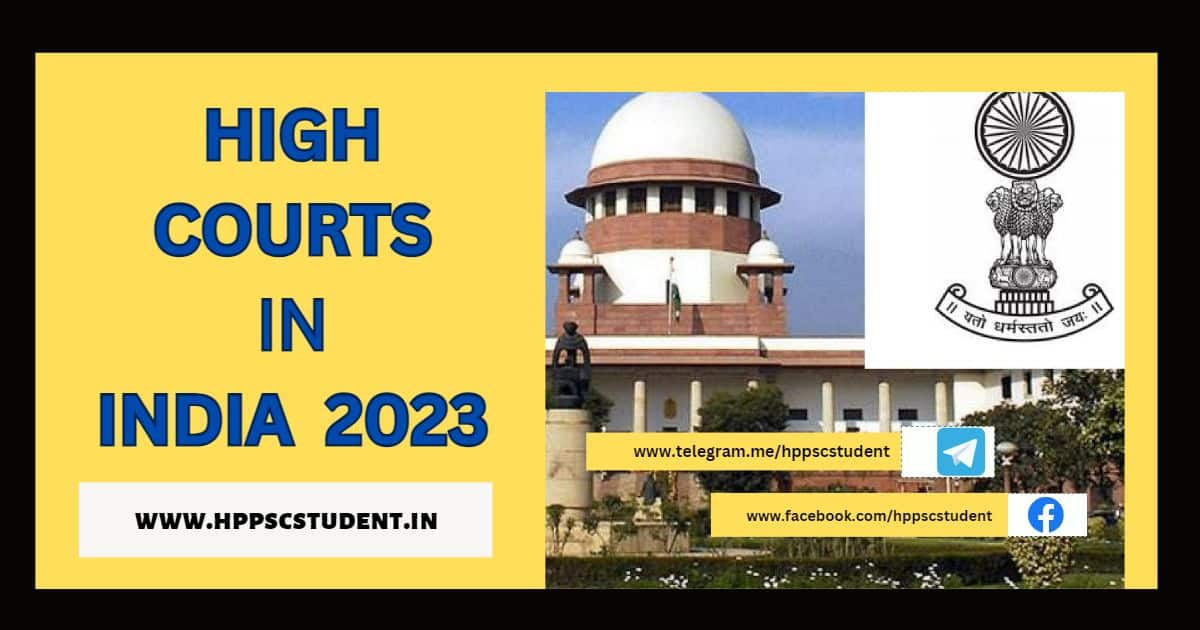
Welcome to my blog where we delve into the fascinating world of High Courts in India. As the name suggests, High Courts are the highest judicial authority in each state of India, with the power to hear appeals and try cases both civil and criminal. With 25 High Courts spread across the country, they play a crucial role in ensuring justice and upholding the rule of law. In this blog, we will explore the history, functioning, and significance of High Courts in India, shedding light on their critical role in the Indian legal system.
- The High Court of a State is the highest court of the State and all other courts of the State work under it.
- Normally there is one High Court in every State but there can be only one High Court for two or more States as well (Article 231), according to the constitution.
- There are 25 High Courts in India.
- The Calcutta High Court, established in 1862, is the oldest High Court in India. The Bombay and Madras High Courts were also established in the same year.
- The newest High Courts are the Telangana Court and Andhra Pradesh High Court, both established in the year 2019.
- In every High Court, there is a Chief Justice and many other judges whose number is defined by the President of India.
- The Bombay, Madras and Calcutta High Courts are the three Chartered High Courts in India
- The Madras Law Journal, published by the Madras High Court, was the first journal in India dedicated to reporting judgements of a Court (1891).
Women Premier League 2023 Exam Facts
Total High Courts in India
- The total number of high courts in India is 25. The latest addition to the list is the Andhra Pradesh High Court, which was established in 2019 after the state of Andhra Pradesh was split into two separate entities. The list of High Courts for all states and union territories with established year is given below:
| Name | Year | Territorial Jurisdiction | Seat |
|---|---|---|---|
| Allahabad | 1866 | Uttar Pradesh | Allahabad (Bench at Lucknow) |
| Andhra Pradesh | 2019 | Andhra Pradesh | Amravati |
| Bombay | 1862 | Maharashtra, Dadar & Nagar Haveli, Goa, Daman & Diu | Mumbai (Bench at Panaji, Aurangabad, and Nagpur) |
| Chhattisgarh | 2000 | Chhattisgarh | Bilaspur |
| Chennai | 1862 | Tamil Nadu & Pondicherry | Chennai (Bench at Madurai) |
| Delhi | 1966 | Delhi | Delhi |
| Gujarat | 1960 | Gujarat | Ahmedabad |
| Guwahati | 1948 | Assam, Nagaland, Mizoram, and Arunachal Pradesh | Guwahati (Bench at Kohima, Aizawl, and Itanagar) |
| Himachal Pradesh | 1966 | Himachal Pradesh | Shimla |
| Jammu & Kashmir | 1928 | Jammu & Kashmir | Srinagar & Jammu |
| Jharkhand | 2000 | Jharkhand | Ranchi |
| Karnataka | 1884 | Karnataka | Bengaluru (Bench at Dharwad and Gulbarga) |
| Kerala | 1958 | Kerala & Lakshadweep | Ernakulam |
| Kolkata | 1862 | West Bengal, Andaman & Nicobar Islands | Kolkata (Bench at Port Blair) |
| Madhya Pradesh | 1956 | Madhya Pradesh | Jabalpur (Bench at Indore, Gwalior) |
| Manipur | 2013 | Manipur | Imphal |
| Meghalaya | 2013 | Meghalaya | Shillong |
| Orissa | 1948 | Odisha | Cuttack |
| Patna | 1916 | Bihar | Patna |
| Punjab & Haryana | 1947 | Punjab, Haryana, Chandigarh | Chandigarh |
| Rajasthan | 1949 | Rajasthan | Jodhpur (Bench at Jaipur) |
| Sikkim | 1975 | Sikkim | Gangtok |
| Telangana | 2019 | Telangana | Hyderabad |
| Tripura | 2013 | Tripura | Agartala |
| Uttarakhand | 2000 | Uttarakhand | Nainital |
Appointment of the Judges
- The Chief Justice of a High Court is appointed by the President with the consultation of the Chief Justice of the Supreme Court and the Governor of the State.
- The other judges are appointed by the will of the President, Governor and the Chief Justice of the High Court.
Union Budget 2023-24 Highlights
Qualifications for the Judges
- He should be a citizen of India.
- He should have been an advocate in one or more High Courts in India or a judge for at least 10 years in subordinate courts in India.
Tenure:
- Originally the age of the retirement of the judges of the High Courts was fixed at 60 but it was raised to 62 in 1963 according to the 15th amendment of the Constitution.
Removal of the Judges
- A judge may leave his office by resigning. He will send his letter of resignation to the President.
- His office would be considered to have been vacated if he is appointed as a judge of the Supreme Court or is transferred to some other High Court.
- A judge of a High Court may also be removed like a judge of the Supreme Court. A judge of the High Court may be removed by the President of the Parliament passes a motion against him by an absolute majority and 2/3rd majority of the members present and voting, both Houses sitting separately.
Salary of High Court Judge
- The pay of the Chief Justice of a High Court is rupees 280,000/- per month and that of the other judges is rupees 250,000/- per month.
Powers and Functions of the High Court in India
- High Court has the following jurisdiction and powers:
- 1) Power to issue certain writs:– Each High Court possesses the authority to issue writs of habeas corpus, mandamus, prohibition, quo warranto, and certiorari with the aim of enforcing Fundamental Rights or achieving other objectives.
- 2) Power of Superintendence: The jurisdiction of each High Court includes supervision over all Courts and Tribunals situated within the territories under its purview.
- 3) Power to transfer case: When a High Court determines that a case being heard in a lower court under its jurisdiction pertains to a significant constitutional matter whose interpretation is critical to resolve the case, it has the power to withdraw the case. The High Court may then either adjudicate the case itself or determine the constitutional question and return the case, along with a copy of its decision, to the original court for resolution in accordance with the judgement.
- 4) Consultation in the appointment and posting etc. of District Judges: The High Court is consulted by the Governor in the appointment, posting and promotion of District Judges. It is also consulted in the appointment of other members of the State Judicial Service.
- 5) Control over subordinate courts: The High Court is vested with the authority to oversee district courts and other subordinate courts, including matters related to the appointment, promotion, and granting of leave to personnel who belong to the judicial service of a State and hold a position lower than that of a district judge.
- 6) Other original and appellate powers: High Court has original and appellate jurisdiction in civil and criminal matters as conferred by the Codes of Civil and Criminal Procedure and the Letters of Patent.
Exam Oriented MCQ Question with Answers
1. What is the highest court of a State in India?
- A) Supreme Court
- B) District Court
- C) High Court
- D) Magistrate Court
Answer: C) High Court
2. How many High Courts are there in India?
- A) 15
- B) 20
- C) 25
- D) 30
Answer: C) 25
3. Which is the oldest High Court in India?
- A) Bombay High Court
- B) Calcutta High Court
- C) Madras High Court
- D) Delhi High Court
Answer: B) Calcutta High Court
4. When were the Bombay and Madras High Courts established?
- A) 1861
- B) 1862
- C) 1863
- D) 1864
Answer: B) 1862
5. Which are the newest High Courts established in India?
- A) Delhi and Mumbai High Courts
- B) Telangana and Andhra Pradesh High Courts
- C) Kerala and Karnataka High Courts
- D) Rajasthan and Punjab High Courts
Answer: B) Telangana and Andhra Pradesh High Courts
Explanation: High Courts are an essential part of India’s judicial system. There are 25 High Courts in India, and the High Court of a State is the highest court of that State. The Bombay, Madras, and Calcutta High Courts are the three Chartered High Courts in India, and the Calcutta High Court is the oldest High Court established in India in 1862. The Telangana and Andhra Pradesh High Courts are the newest High Courts established in the year 2019.
6. What is the process of appointing a Chief Justice of a High Court in India?
- A) The Chief Justice of the Supreme Court appoints them directly.
- B) The Governor of the State appoints them.
- C) The Chief Justice of the High Court appoints themselves.
- D) The President consults with the Chief Justice of the Supreme Court and the Governor of the State.
Answer: D) The President consults with the Chief Justice of the Supreme Court and the Governor of the State.
Explanation: The appointment of a Chief Justice of a High Court in India is done by the President after consulting with the Chief Justice of the Supreme Court and the Governor of the State. This is mentioned in the Indian Constitution, and it ensures that the appointment is made in a fair and impartial manner. This process helps to maintain the independence of the judiciary and ensures that the Chief Justice is chosen based on merit and qualifications. The term of the Chief Justice is also determined by the President, based on recommendations from the Chief Justice of the High Court and the Chief Justice of the Supreme Court.
7. What is the retirement age of judges of the High Courts in India?
- A) 60
- B) 61
- C) 62
- D) 63
Answer: C) 62
Explanation: The retirement age of judges of the High Courts in India was originally fixed at 60 but it was raised to 62 in 1963 according to the 15th amendment of the Constitution.
8. How can a judge of a High Court leave his office?
- a) By being appointed as a judge of the Supreme Court
- b) By sending his resignation letter to the Prime Minister
- c) By being transferred to a different High Court
- d) By completing his term of office
Answer: a) By being appointed as a judge of the Supreme Court
Explanation: According to the given information, a judge of a High Court can leave his office by resigning or being appointed as a judge of the Supreme Court or being transferred to a different High Court. Therefore, option a) is the correct answer.
9. How can a judge of a High Court be removed?
- a) By the Governor of the State
- b) By the President of India
- c) By the Chief Justice of India
- d) By the Prime Minister
Answer: b) By the President of India
Explanation: As per the given information, a judge of the High Court can be removed by the President of India if the Parliament passes a motion against him by an absolute majority and 2/3rd majority of the members present and voting, both Houses sitting separately. Therefore, option b) is the correct answer.

![HP Subordinate Allied Services Main Exam 2024 [General Studies Paper]](https://hppscstudent.in/wp-content/uploads/2025/03/HP-Subordinate-Allied-Services-Main-Exam-2024-General-Studies-Paper.webp)